
As classrooms continue to evolve, schools are embracing smarter technologies to create more collaborative, engaging, and future-ready learning environments. A smart interactive panel has emerged as a powerful solution, with an interactive flat panel display making lessons more interactive through touch-enabled collaboration, multimedia content, and real-time annotation.
Five major signs your school needs an interactive flat panel display can help you determine whether it’s time to upgrade your classrooms and deliver a more engaging learning experience for both teachers and students
Why Schools Are Moving Towards Interactive Learning
Education has evolved significantly over the past decade. Today’s students learn best through visual, interactive, and collaborative experiences, prompting schools to adopt technology that makes learning more engaging and effective.
This shift is already evident across educational institutions, where more than 2,000 campuses are using over 15,000 interactive panels to support the learning of over one million students every day. Smart Interactive Panels have become an essential part of modern classrooms, enabling teachers to deliver engaging lessons while fostering collaboration and creating future-ready learning environments.
Benefits include:
- Improved student engagement
- Better collaboration
- Real-time annotations
- Multimedia learning
- Easy content sharing
- Hybrid learning support
- Reduced dependency on multiple devices
This advanced classroom technology helps teachers deliver lessons more effectively while making learning enjoyable.
Students Are Losing Focus During Traditional Board Lessons
Have you ever noticed how students can sit through a two-hour movie, binge-watch an entire series, or spend hours exploring interactive content online, yet struggle to stay focused during a classroom lecture?
The difference is not their attention span; it’s the experience.
Movies, games, and digital content keep learners engaged through visuals, motion, storytelling, sound, and interaction. They don’t just present information; they create an experience. As a result, the brain stays actively involved instead of passively receiving information.
The same principle applies in education.
In many traditional classrooms, students still spend a significant portion of the lesson copying notes from a chalkboard or whiteboard. While this method has long been a part of teaching, it often leaves little room for exploration, discussion, or visual understanding.
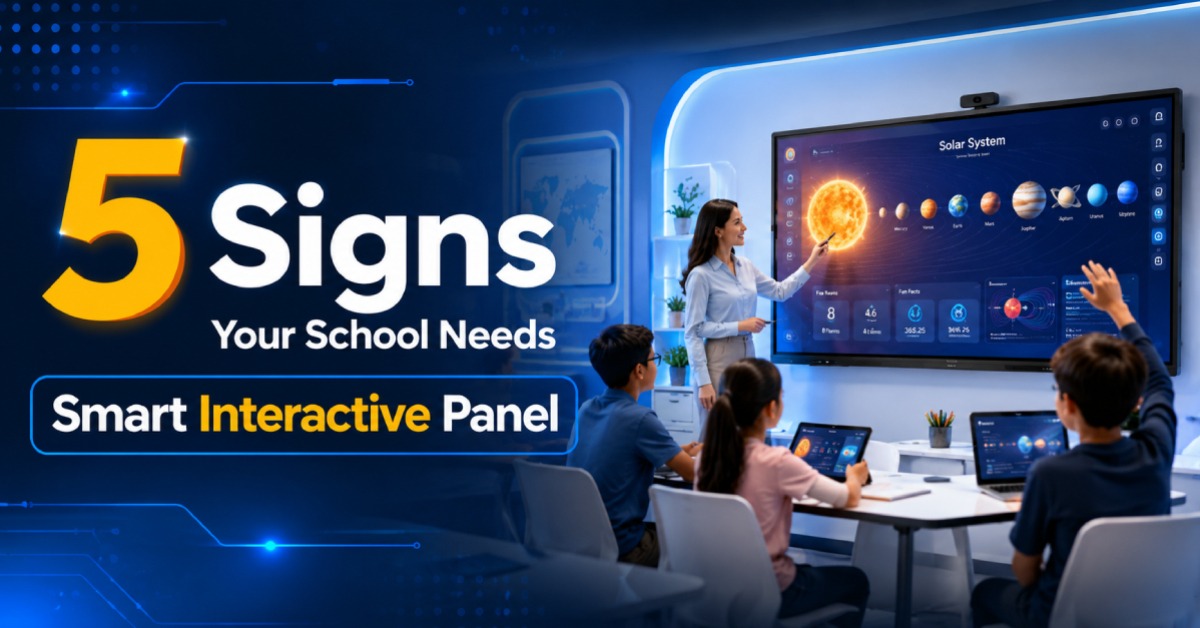
This is where an interactive display for the classroom changes the learning experience. Instead of explaining the solar system with static drawings, for example, teachers can rotate planets in 3D, zoom into galaxies, or play NASA videos instantly. An interactive flat panel display transforms passive instruction into active exploration, helping students understand concepts more clearly and retain them for longer.
Teachers Are Juggling Multiple Teaching Devices
A teacher walks into the classroom, ready to begin the lesson. But instead of teaching, the first few minutes are spent connecting a laptop, turning on the projector, plugging in HDMI cables, and hoping everything works as expected.
Many classrooms still rely on multiple devices, including:
- Laptop
- Projector
- Whiteboard
- Speakers
- Document camera
- HDMI cables
Every minute spent switching between devices is a minute taken away from learning. A smart interactive panel combines these tools into one seamless solution, while an interactive flat panel display helps teachers focus on teaching, not troubleshooting.
Your Classrooms Still Depend on Chalkboards or Old Projectors
Many schools continue using outdated equipment that no longer meets today’s educational expectations.
Common Problems with Traditional Boards
- Poor visibility
- Chalk dust
- Projector shadows
- Frequent bulb replacement
- Low image quality
- Maintenance costs
Modern classrooms demand smarter solutions. Students at the back of the classroom enjoy the same viewing experience as those in the front.
Hybrid Learning Feels Difficult to Manage
Picture a classroom where a few students are attending in person while others have joined from home due to illness or school events. The teacher is trying to explain a concept, share notes online, answer questions from remote students, and ensure everyone stays on the same page. Managing different platforms and devices at the same time can quickly become overwhelming.
Today’s schools are increasingly conducting the following:
- Hybrid classes for in-person and remote learners
- Online revision sessions before exams
- Virtual parent-teacher meetings
- Teacher training and professional development
- Collaborative sessions with educators across campuses
A smart interactive panel simplifies hybrid teaching by bringing everything together in one place. With an interactive flat panel display, teachers can conduct live online classes, share lesson content instantly, annotate in real time, and ensure every student, whether in the classroom or joining remotely, has the same interactive learning experience.
Students Remember Notes but Not the Learning Experience
Memorising information is no longer enough.
Schools now focus on:
- Critical thinking
- Creativity
- Collaboration
- Communication
- Problem-solving
Interactive learning improves knowledge retention because students actively participate.
How Interactive Technology Improves Classroom Learning
Visual Learning
Students understand difficult concepts faster using:
- 3D models
- Animations
- Infographics
- Videos
Example
Instead of drawing photosynthesis manually, teachers can display an animated process showing sunlight, water, carbon dioxide, oxygen, and glucose in real time.
Better Student Collaboration
A classroom interactive panel allows multiple students to write simultaneously.
Teachers can conduct:
- Team activities
- Collaborative problem-solving
- Interactive brainstorming
- Classroom competitions
Learning becomes more inclusive and engaging.
Easy Content Sharing
With an interactive display panel, teachers can instantly:
- Share notes
- Display student work
- Mirror mobile devices
- Connect laptops
- Access cloud storage
Students no longer need to wait for handwritten notes.
Why Schools Prefer Interactive Flat Panels Over Projectors
Many institutions are replacing projectors with interactive flat panel display education solutions.
| Projector | Interactive Flat Panel |
| Bulb replacement | No bulbs |
| Low brightness | Bright 4K display |
| Shadow issues | No shadows |
| Frequent maintenance | Low maintenance |
| Limited interaction | Multi-touch collaboration |
| Lower lifespan | Longer operational life |
An interactive flat panel display provides greater durability and lower long-term operating costs.
The Future of Smart Classrooms
Technology is transforming education at an unprecedented pace.
Modern smart interactive panels for schools support:
- AI-assisted teaching
- Digital assessments
- Collaborative classrooms
- Personalized learning
- Hybrid education
- Cloud-based content
Schools embracing these innovations provide students with skills that extend beyond textbooks.
This smart classroom investment is becoming an essential requirement rather than a luxury.
Conclusion
Education is evolving, and classrooms need technology that keeps pace with changing learning needs. If your school is facing low student engagement, outdated teaching tools, or challenges in managing hybrid learning, it may be time to upgrade to an interactive flat panel display.
NextGEN delivers smart classroom solutions designed to make teaching more interactive, collaborative, and effective. With advanced smart interactive panels, schools can create engaging learning experiences while preparing students with the digital skills they need for the future. Take the first step towards smarter classrooms with NextGEN and redefine the way learning happens.
Frequently Asked Questions (FAQs)
1. What is an Interactive Flat Panel Display?
An interactive flat panel display is a touch-enabled digital teaching screen that combines a whiteboard, computer, projector, and collaboration tools into a single device for interactive classroom learning.
2. Why are interactive flat panels better than projectors?
Interactive flat panels provide brighter 4K displays, eliminate shadows, require minimal maintenance, support multi-touch interaction, and offer a longer lifespan compared to traditional projectors.
3. How does an interactive panel improve student engagement?
Interactive panels use multimedia, real-time annotations, educational apps, quizzes, and collaborative activities to keep students actively involved, making lessons more engaging and memorable.
4. Are interactive flat panels easy for teachers to use?
Yes. Most interactive flat panels feature intuitive interfaces, built-in whiteboards, annotation tools, screen sharing, and compatibility with common educational software, making them easy to learn and use.
5. What screen size is best for a school classroom?
The ideal screen size depends on classroom dimensions and student capacity. Common sizes include 65-inch, 75-inch, and 86-inch displays, ensuring clear visibility for all students.